



The Lie
You publish the book.
You build the website.
You put up the cover, the description, your author bio and a mailing-list signup.
Maybe you’ve even got a blog.
That’s the funnel, right?
Book leads to website. Website leads to newsletter. Newsletter leads to next book.
Done.
Except there’s a problem with that model.
It assumes the thing your reader wants immediately after finishing your book is another transaction.
Usually it isn’t.
If you’ve done your job well, your reader is curious.
They want to know more.
Who was that character really?
What was on the other side of that mountain?
What happened during the war everyone keeps mentioning?
Is there a map?
What does that creature look like?
Why was that old wizard terrified when someone mentioned the ruins?
And that’s where a traditional author website frequently fails.
It tells readers about the author.
It tells readers about the books.
It might even sell the books.
But it doesn’t necessarily let them enter the world.
That’s a very different job.
The Cost
Think about what happens when someone reaches the end of a story they genuinely loved.
For a few minutes, they’re carrying around something incredibly valuable:
Emotional momentum.
They don’t want to leave yet.
That’s the moment most writers waste.
The reader finishes the book, searches for the author, lands on a website and finds:
Books.
About Me.
Newsletter.
Contact.
Maybe merchandise.
All useful things.
But the reader wasn’t looking for your contact form.
They wanted back into the story.
And we handed them paperwork.
That’s what I mean when I say a website can become a wall.
You built a beautiful front door into your fictional universe, but there aren’t any rooms behind it.
The reader can’t wander.
They can’t investigate.
They can’t follow the strange character they met in chapter seven down some ridiculous rabbit hole and discover three pieces of history, an old map and a cultural tradition that never made it into the novel.
They can’t explore.
So…they leave.
And curiosity doesn’t wait around politely.
Five minutes later, YouTube has them.
Netflix has them.
Another author has them.
Some guy explaining how the Roman Empire collapsed has them.
Your opportunity didn’t disappear because your story wasn’t interesting.
It disappeared because you gave their interest nowhere to go.
That’s Why I Use World Anvil
This is one of the reasons I’ve used World Anvil for the Wanted Hero universe since 2019.
I don’t use it because I needed another website.
Good grief.
The last thing I needed was another website.
I use it because World Anvil does a completely different job.
Life of Fiction is my flagship.
That’s where the relationship lives.
That’s where people read stories, follow the serials, hear from me and come back week after week.
World Anvil is the candy store.
That’s where I want you to go when you’ve finished reading something and you’re still hungry.
Maybe you want to know more about the character you just met.
Fine.
Go find him.
Maybe you want to understand the city he grew up in.
Click the city.
Now you’ve discovered the culture.
That leads to the government.
That leads to an old war.
That leads to a historical character.
That leads to an artifact.
Forty-five minutes later you’re six articles away from the thing that brought you there in the first place.
Perfect.
That’s exactly what I want.
Because you’ve stopped consuming a book and started exploring a world.
Those are two very different relationships.
One Platform Holds the Relationship. World Anvil Holds the Depth.
This distinction is important.
Writers frequently ask one platform to do everything.
Website.
Blog.
Newsletter.
Store.
Community.
World encyclopedia.
Story archive.
Search engine.
Reader engagement.
[WHEW!]
And then we wonder why everything feels thin?
I don’t want one platform doing everything badly.
I want different tools doing specific jobs extremely well.
For me, Life of Fiction creates rhythm.
There’s another story coming.
There’s another conversation happening.
There’s a reason to return.
World Anvil creates depth.
There’s always another door.
That’s the ecosystem.
The story says: Come with me.
World Anvil says: While you’re here, look around.
That’s the piece I think many writers are missing.
This Isn’t “Bonus Content”
And I want to make an important distinction here.
I’m not talking about dumping deleted scenes somewhere and calling it worldbuilding.
This is about treating your fictional world as something readers can experience independently of an individual book.
World Anvil is particularly interesting to me because it was built around relationships between information.
Characters belong to organizations.
Organizations operate in places.
Places have histories.
Historical events involve people.
People possess objects.
Objects have origins.
Cultures have beliefs.
Governments have conflicts.
Suddenly those disconnected notes hiding in twenty-three folders on your computer become an interconnected world a reader can actually navigate.
That’s powerful.
Because your 90,000-word novel may only reveal five percent of what you’ve created.
Why should the other ninety-five percent remain trapped on your hard drive?
Not all of it belongs in the novel.
Please don’t put all of it in the novel.
Your readers don’t need a seventeen-page explanation of the sewer system just because you spent Thursday designing it.
But somebody might absolutely love discovering that information later.
That’s where World Anvil becomes useful.
The novel stays a novel.
The world gets to become something larger.
The Difference Between a Reader and a Fan
This is also where the conversation stops being purely about marketing.
Marketing asks:
How do I get this person to buy another book?
Worldbuilding asks:
How do I make this person care enough that they want to remain here?
That’s a much more interesting question.
A reader finishes your story.
A fan remembers the inn.
A reader knows your protagonist’s name.
A fan knows his hometown.
A reader recognizes your world.
A fan has favorite places inside it.
A reader buys the next novel because they liked the previous one.
A fan buys the next novel because they want to go home.
That’s what we’re really building.
Not traffic.
Attachment.
And AI Makes This More Important, Not Less
There’s another reason I think this matters much more now than it did a few years ago.
Readers increasingly ask questions instead of simply typing keywords into a search box.
They ask AI systems about books, characters, fictional settings, reading orders, magic systems and lore.
That changes the value of having your fictional universe publicly documented.
A typical author website might give an AI system a biography, some sales copy and a handful of blog posts.
A properly developed World Anvil presence can give it something considerably more useful:
Structure.
Characters connected to places.
Places connected to nations.
Nations connected to history.
History connected to conflicts.
Conflicts connected to people.
In other words, context.
And context is enormously valuable in an internet increasingly mediated by systems trying to understand relationships between information.
That’s one reason I don’t think authors should look at a worldbuilding platform as some nerdy little side project.
It can become part of your discoverability infrastructure.
You’re not merely documenting your world for existing fans.
You’re making your world understandable.
Those are going to become increasingly different things.
Don’t Build 500 Articles Tomorrow
Now comes the part where writers make everything complicated.
Don’t.
You do not need to spend the next six months documenting the agricultural practices of twelve imaginary kingdoms.
Start where your reader’s curiosity already exists.
Ask one question:
When somebody finishes this book, what are they most likely to want to know more about?
Maybe it’s the villain.
Build the villain.
Maybe it’s the city.
Build the city.
Maybe it’s the magic system.
Build that.
Maybe it’s the strange creature that appeared for three pages and nearly ate everyone.
Definitely build that.
Create the article in World Anvil.
Make it worth reading.
Add images if you have them.
Connect it to other relevant pieces of your world.
Then put a door to it somewhere your reader will see.
At the end of the book.
In your newsletter.
Under the serial episode.
Inside your author’s notes.
On your primary website.
You don’t have to tell readers:
Please visit my World Anvil page.
That’s asking them to care about your platform.
They don’t.
Tell them:
Want to know what Wendell still doesn’t know about this place?
Now you have my attention.
The Door
That’s the shift.
Stop treating your website as the final destination.
Your website may be your headquarters.
Your newsletter may maintain your relationship with readers.
Your books may remain the heart of everything you’re doing.
But when readers finish a story and don’t want to leave yet, give them somewhere to go.
That’s the role World Anvil fills for me.
It’s the room behind the door.
The shelves behind the counter.
The map readers can unfold when the book only showed them one road.
The candy store.
Pick one thing your readers already care about.
A character.
A city.
A creature.
A piece of history.
A mystery.
Build it properly in World Anvil.
Connect it to the story they already love.
Then give them the door.
Because the worst time to tell someone there’s nothing else to see is precisely when you’ve finally made them want more.
Listen to my full conversation with Deleyna Marr: 🎙 EPISODE 16: Why Should Fiction Writers Use World Anvil and Substack Together?
Want the deeper strategy for using World Anvil to turn your fiction into something readers can explore instead of simply finish? Read the full deep dive: How Do You Build a Two-Platform Author Business for Free?
Your Turn
When your reader reaches The End and still wants more, have you built them a door deeper into your world...or are you forcing them to leave?
Join Us
If this hit home, subscribe for more unfiltered truth about writing life, mindset, and creative courage.
If you want the deep-dive framework that shows you how to build a sustainable audience without chasing algorithmic favor, it’s waiting for you in the paid companion article.
About This Podcast
Nothing About This Is Safe is the monthly writing-truth podcast hosted by , featuring candid conversations with working authors. We go after the real questions fiction writers actually search for ... craft, identity, mindset, publishing reality, money, and creative survival ... without sugarcoating and without performance.
If a writer is looking for an honest answer, these are the conversations you want to listen to.
Jaime Buckley
Nothing about this is safe, but it’s worth it.
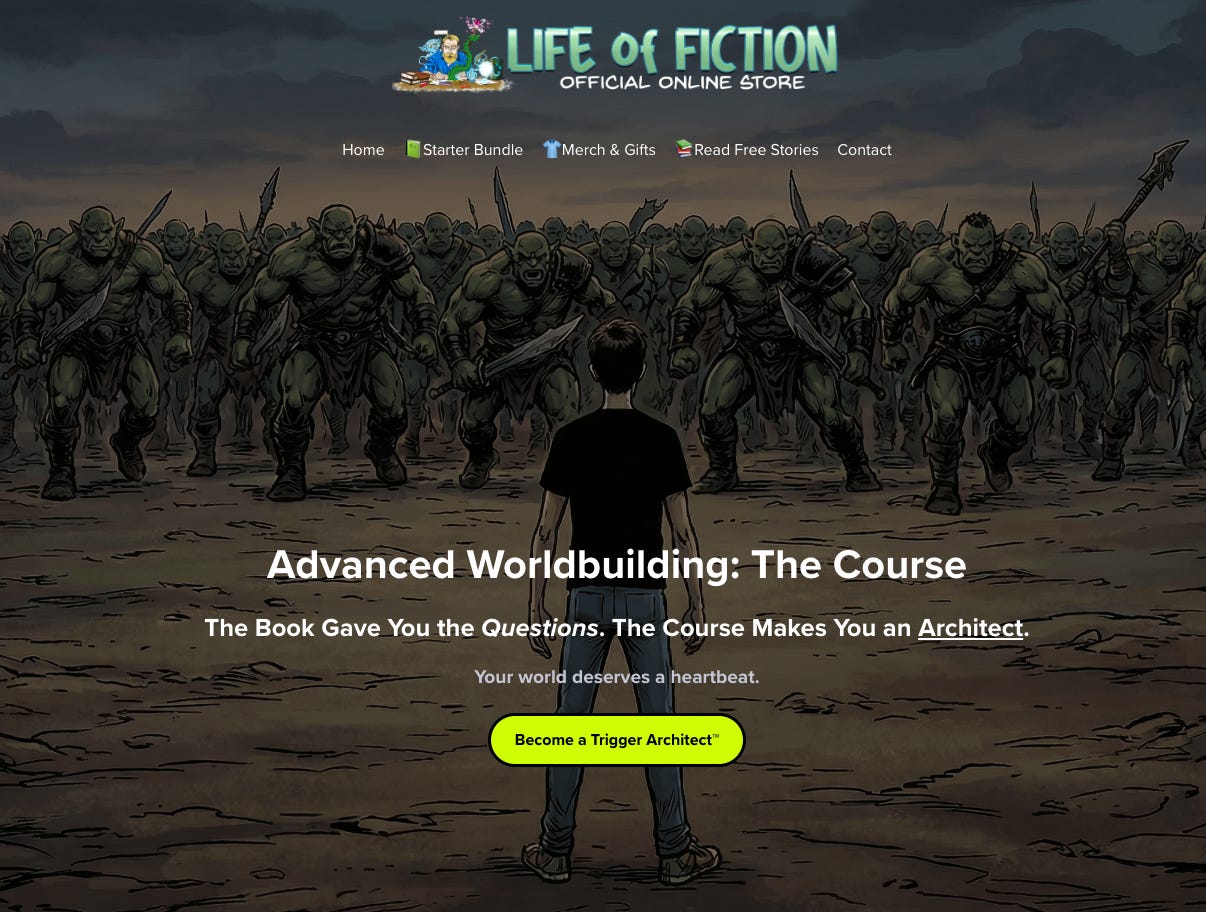
Advanced Worldbuilding: The Course
You can feel it when a world is hollow. So can your readers.
You have poured years into your world. The maps, the names, the history nobody asked for yet. And still there is that quiet fear that it is a beautiful set with no foundation...that a sharp reader could push on it and the whole thing would wobble.
Detail is not the problem.
Structure is.
That is exactly what this course fixes.
Inside, Jaime Buckley hands you the same system he used to build a world people have followed for over thirty years. Using the Up-Chuck Method™ and the discipline of Trigger Questions, you will learn to:
Design catalytic Events that force your story to move
Define a living Core so every choice in your world traces back to something that matters
Find and cut the structural weakness before a reader ever feels it
Build a world that holds up under scrutiny...and lingers long after the last page
This is not a creativity workshop. It is architectural training for serious builders. If you believe your story deserves more than surface detail, this is where you stop decorating and start engineering.
Your readers will never see the framework. They will only feel that your world is real.
Build the world that outlives you.