


The Real Problem
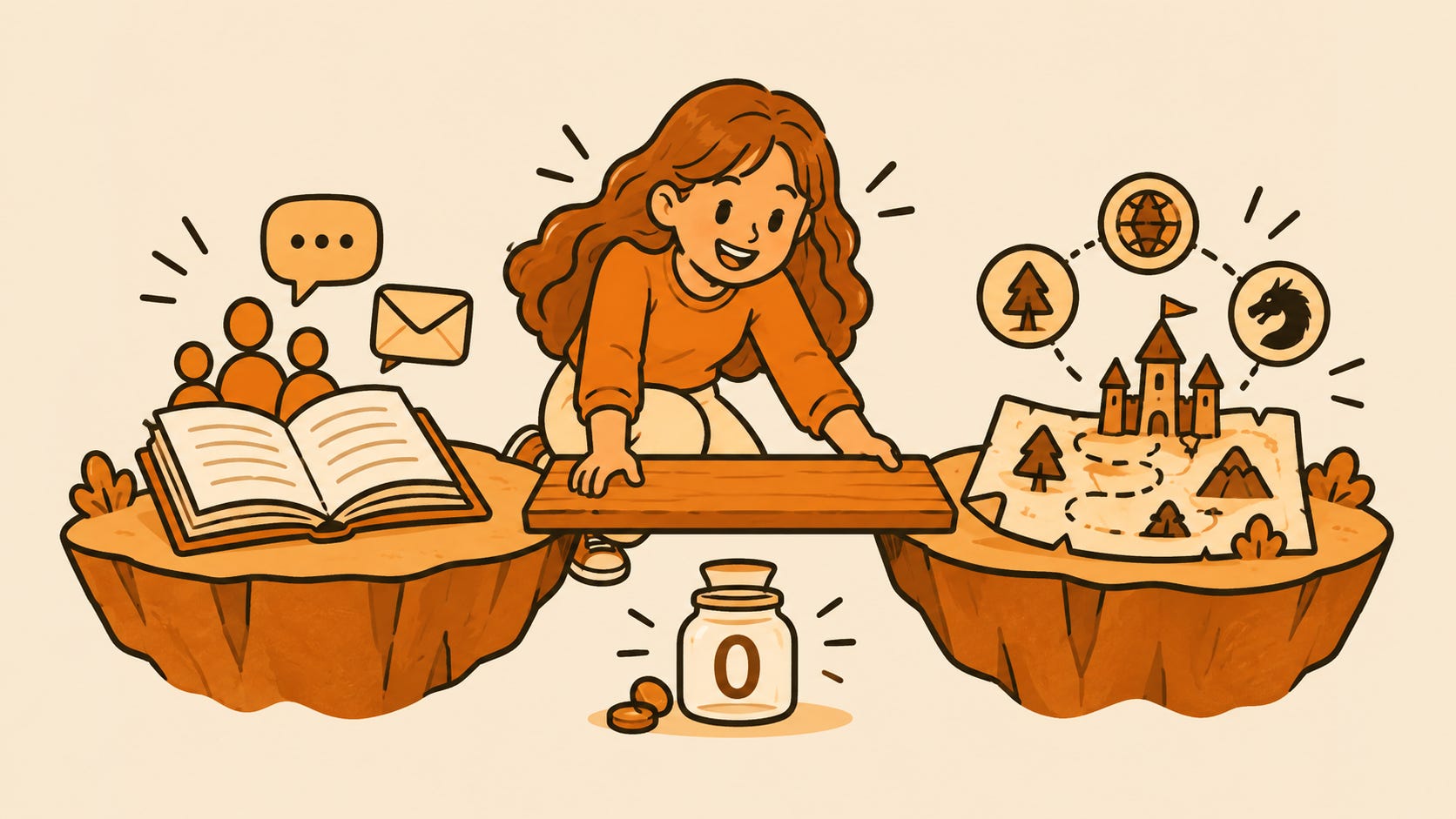
The last article named the wound: one platform can’t hold both jobs a fiction author needs done.
But knowing that doesn’t tell you what to build, in what order, or how to pay for it without going broke chasing tools.
Jaime used to run this same business on roughly $438 a month in scattered software.
Deleyna tried the same thing, with the same result: a pile of subscriptions doing badly what two free platforms now do well, together.
The Framework: Flagship + Candy Store
We want everyone to benefit from this information.
Our business has been using World Anvil since 2019.
We’re not an affiliate, just a user [cue Tron Legacy music], and that platform has been one of THE best tools we have ever used as writers…both for discovery and generating a living from our creativity.
Step one: Pick your flagship.
This is the platform that holds the relationship.
It’s where the serial lives, where readers hear from you in real time, where a new person lands first.
Jaime uses Substack because it does, for free, what he used to pay hundreds a month for elsewhere: publishing, subscriber management, and a reading experience good enough that he reads on his phone now, which he never did before.
Ever.
Step Two: Pick your candy store.
This is the platform that holds the depth.
It’s where a reader goes after they’re hooked, to fall down a rabbit hole of characters, places, and lore.
Jaime and Deleyna both use World Anvil for this.
It started as a tool for gamers and worldbuilders and has grown, by their own website, into a platform holding over 7 million fictional worlds.
Something important to note: neither Jaime nor Deleyna has found another world that looks like theirs.
Why?
Because the platform is built to let a world be exactly as strange as it needs to be.
No two are alike.
Step Three: Build the connective tissue, not the whole world at once.
Neither platform rewards a writer who tries to map everything before writing anything.
Deleyna’s advice, verbatim: don’t try to learn it, try to do a thing.
Pick one door.
Write one article about the one part of your world you’re most excited about right now.
World Anvil’s auto-linking will start connecting it to the next thing you build, and the next, until doors that were closed start opening on their own.
Jaime’s version of the same advice is a hallway with closed doors on both sides.
It doesn’t matter which one you open first.
Open it, write what’s inside, and eventually you’ll open a door that’s already connected to something else you built.
That’s the platform doing its job, not you doing extra work to force connections that aren’t there yet.
This matters for a practical reason too: World Anvil’s search actually finds what you put into it.
Deleyna’s been burned before by a story detail dropped into a stray Google Doc or a Word file, gone for good.
Put a character’s eye color, their family tree, their history into a linked article once, and you can find it again in seconds, months later, when you’ve forgotten you ever wrote it.
Step Four: Use the account tier that matches the job, not the one that’s cheapest to try.
Both Jaime and Deleyna run World Anvil at the Sage level, the tier built for people running this as a business rather than a hobby.
Sage comes with a full library of professional classes, and a Discord full of other business owners and entrepreneurs teaching each other in real time.
When someone’s stuck, someone else already solved it and points them to the lesson. That’s not a small perk, it’s most of the “figuring it out” work already done for you by people ahead of you on the same road.
Start on the free tier to see if the platform fits your hand. Once you know it does, don’t nickel-and-dime the climb the way Jaime did his first year.
Go straight to the tier that matches what you’re actually building.
Step Five: Let each platform do its own job for the AI librarian.
Readers ask questions now instead of typing keywords.
The AI systems answering those questions need structured, connected, public content to pull from.
World Anvil’s article-and-link structure is exactly that kind of feast.
Substack’s public notes and posts get indexed fast.
Jaime’s read is blunt:
“If you have work you want an AI to find and recommend, mark it public and let the structure do its job; if you have spoilers or subscriber-only material, World Anvil’s privacy controls let you wall it off cleanly.”
Deleyna does this deliberately, publishing early material openly and holding back anything that depends on a twist the reader hasn’t earned yet.
It’s also worth building your longer work directly in World Anvil’s Manuscripts tool rather than a separate word processor.
Publish from there and readers get a real reading experience, first chapters free, the rest behind a subscription or a sale.
Your choice.
The writing itself becomes one more piece of the connected world instead of a file sitting outside it.
Step six: Answer Honestly.
Before you add a third platform, a fourth tool, or another monthly charge, ask yourself:
Is this doing a job my flagship or my candy store can’t already do?
If the honest answer is no, you don’t need it.
Jaime’s own rule, learned the expensive way:
It either pays for itself, or you don’t do it.
One Warning
This only works if you actually use both platforms as intended.
A World Anvil account full of half-finished articles nobody can find isn’t a candy store, it’s a junk drawer.
A Substack with no publishing rhythm isn’t a flagship, it’s an abandoned storefront.
The split only pays off once each platform is actually doing its job.
The Worksheet
Use the attached Worksheet PDF to map your own two-platform build:
What is the ONE thing about my world I’m most excited to write about right now?
Where does my reader relationship currently live, and is it actually working as a flagship?
What is one piece of lore, one character, or one place I could publish this week as my first “door”?
What in my world is spoiler-sensitive and needs to stay private for now?
Answer Honestly: what tool or platform am I paying for that isn’t earning its keep?
What Changes
Once this is running, a reader who finishes your serial has somewhere to go, and that somewhere deepens their attachment instead of ending it.
Your world stops living in scattered documents no one, including you, can find again.
And instead of chasing every reader by hand, you have two platforms built to be found doing that work quietly, all the time, whether you’re online or not.
Listen to the Episode
This deep-dive expands on our conversation in Episode 15 of Nothing About This Is Safe.
If you haven’t listened yet, you can hear the whole discussion here:
🎙 EPISODE 16: Why Should Fiction Writers Use World Anvil and Substack Together?
…and if you missed it:
→ Free Article: What Happens When You Give Readers Nowhere to Go After Your Book?
Final Word
Deleyna put it simply:
The more you put into your world, the more it gives back to you.
That’s true of the platform, and it’s true of the reader.
Build the flagship so people can find you today.
Build the candy store so they never run out of reasons to stay.
Do both, and you’re not just publishing books anymore, you’re building a world someone can move into.
You are MORE than you THINK you are.
So is the story you haven’t finished telling yet.
Now go build something amazing!
About This Podcast
Nothing About This Is Safe is the monthly writing-truth podcast hosted by , featuring candid conversations with working authors. We go after the real questions fiction writers actually search for ... craft, identity, mindset, publishing reality, money, and creative survival ... without sugarcoating and without performance.
If a writer is looking for an honest answer, these are the conversations you want to listen to.
Jaime Buckley
Nothing about this is safe, but it’s worth it.

Advanced Worldbuilding: The Course
You can feel it when a world is hollow. So can your readers.
You have poured years into your world. The maps, the names, the history nobody asked for yet. And still there is that quiet fear that it is a beautiful set with no foundation...that a sharp reader could push on it and the whole thing would wobble.
Detail is not the problem.
Structure is.
That is exactly what this course fixes.
Inside, Jaime Buckley hands you the same system he used to build a world people have followed for over thirty years. Using the Up-Chuck Method™ and the discipline of Trigger Questions, you will learn to:
Design catalytic Events that force your story to move
Define a living Core so every choice in your world traces back to something that matters
Find and cut the structural weakness before a reader ever feels it
Build a world that holds up under scrutiny...and lingers long after the last page
This is not a creativity workshop. It is architectural training for serious builders. If you believe your story deserves more than surface detail, this is where you stop decorating and start engineering.
Your readers will never see the framework. They will only feel that your world is real.
Build the world that outlives you.
I love it when my thinking gets twisted up in a good way, like this column just did. Thanks to you both, Jaime and Deleyna! Very generous.