



I’ve been thinking a lot about what makes readers talk.
Not click.
Not skim.
Not politely nod and move on with their lives.
Talk.
Because that is the real currency for fiction writers now.
Not algorithms.
Not ads.
Not hashtags.
Not clever launch tactics wearing a fake mustache and pretending to be strategy.
Word of mouth.
If you’re paying attention to the pattern in the publishing industry, word of mouth is the future writers actually have a chance to influence.
Notice I didn’t say ‘control’.
That matters.
You cannot force word of mouth. You cannot beg it into existence. You cannot guilt readers into sharing your book. You cannot bribe them into becoming emotionally invested. You cannot stand outside their house with a sandwich board that says, “PLEASE LOVE MY FICTION,” unless you enjoy awkward conversations with law enforcement.
You have to inspire it.
That is where Excitable Value comes in.
‘Excitable Value’ is the quality of a story experience that makes a reader feel something strongly enough that keeping it to themselves becomes difficult.
It is not simply entertainment.
It is not the same as “I liked this book.”
It is the moment a reader closes the story, looks around for someone nearby, and says, “You need to read this.”
That is different.
A story with Excitable Value gives readers layers to connect with. They don’t just read the plot. They attach to the characters. They wonder about the world. They quote the dialogue. They argue about the choices. They imagine what comes next. They want art, maps, side stories, behind-the-scenes notes, songs, lore, discussions, theories, and reasons to stay inside the experience after the last page.
That is the part too many fiction writers miss.
It is not good enough to write a story anymore.
Did you hear me?
It is not good enough to write a story anymore.
Let me say that one more time, so you hear me….
It is not good enough to write a story anymore.
In fact, it’s not good enough to promote a story anymore, either.
You have to help readers experience the story.
Promotion says, “Please buy my book.”
Experience says, “Come inside. Look around. There is more here than you expected.”
That difference matters.
A reader may buy a book because of promotion. But they share a book because of emotional ownership. Something in the story becomes theirs. A character reminds them of who they are. A line says what they could never quite explain. A moment gives them courage. A wound gets named. A hope gets restored. A laugh shows up at exactly the wrong time and somehow makes everything better.
That is Excitable Value.
It is the reader’s emotional reason to care beyond consumption.
Fiction writers need to stop thinking only in terms of “books” and start thinking in terms of entry points. A novel may be the central work, yes, but the reader’s relationship with that story can be deepened through many meaningful layers: short fiction, character letters, world lore, artwork, maps, music, reader guides, discussion prompts, merchandise, podcasts, serialized extras, behind-the-scenes commentary, and community conversation.
Not gimmicks.
Layers.
A gimmick distracts from the story.
A layer deepens the story.
That distinction is everything.
The goal is not to bury readers under bonus content until they need a shovel and a mild sedative. The goal is to give them meaningful ways to connect. Each layer should answer a reader’s natural desire:
“I want to know more.”
“I want to feel that again.”
“I want to share this with someone.”
“I want to belong to the kind of people who love this.”
When readers feel that, they become more than customers.
They become carriers.
That’s what word of mouth really is. A reader carries your story into another conversation because it gave them something worth transporting.
And no, this does not mean every writer needs to build a massive fictional universe. Not every story needs maps, songs, secret archives, ancient bloodlines, and seventeen side characters with tragic childhoods and suspiciously good hair.
But every writer should ask the same hard question:
“What part of this story will make a reader want someone else to feel what they felt?”
If you cannot answer that, your story may still be good.
But good is crowded.
Good is everywhere.
Good is the minimum cover charge.
Since 2005 I’ve been the writer that told creatives, “just don’t suck, and you can succeed.”
That’s no longer the case.
Excitable Value is what makes a story move.
This is especially important for independent fiction writers. We do not control the shelves. We do not control the media. We do not control the algorithms, the industry trends, the retailer policies, or whether some billionaire wakes up and decides to screw over writers who helped make them a billionaire in the first place.
But we can CHOOSE the experience we create.
We can CHOOSE how deeply we understand our readers.
We can CHOOSE how much emotional honesty we put on the page.
We can CHOOSE whether the story has meaningful stakes, lovable people, painful choices, moments of wonder, humor, mystery, and a reason to come back.
We can CHOOSE whether our world feels like a hallway...or a home.
That is where the work is.
That’s also where the opportunity is.
Because readers do not just want content.
They want connection.
They want stories that make them feel braver, wiser, seen, entertained, challenged, comforted, or less alone. They want stories that give them something they can hand to another person and say, “This. This is what I mean.”
This is where I want to slow down over the next few articles.
Because Excitable Value is not just a phrase. It is a craft principle.
It can be studied.
It can be designed.
It can be strengthened.
In this first article, I wanted to define it.
Next, I want to get practical. I want to talk about how writers actually create Excitable Value inside the story itself: through characters readers attach to, choices that matter, emotional stakes, memorable moments, mystery, wonder, humor, and payoff.
Then I want to talk about how we build meaningful layers around that story so readers have more reasons to connect, return, and share.
Not hype.
Not manipulation.
Experience.
That is the future I believe in for fiction writers.
Not louder marketing.
Not more desperate posting.
Not chasing trends until your soul files a complaint.
Build stories with Excitable Value.
Give readers an experience worth entering, remembering, returning to, and sharing.
Because word of mouth cannot be commanded.
It has to be earned.
And the best way to earn it is to create something readers are genuinely excited to give away.
We’ll talk soon.
Jaime Buckley
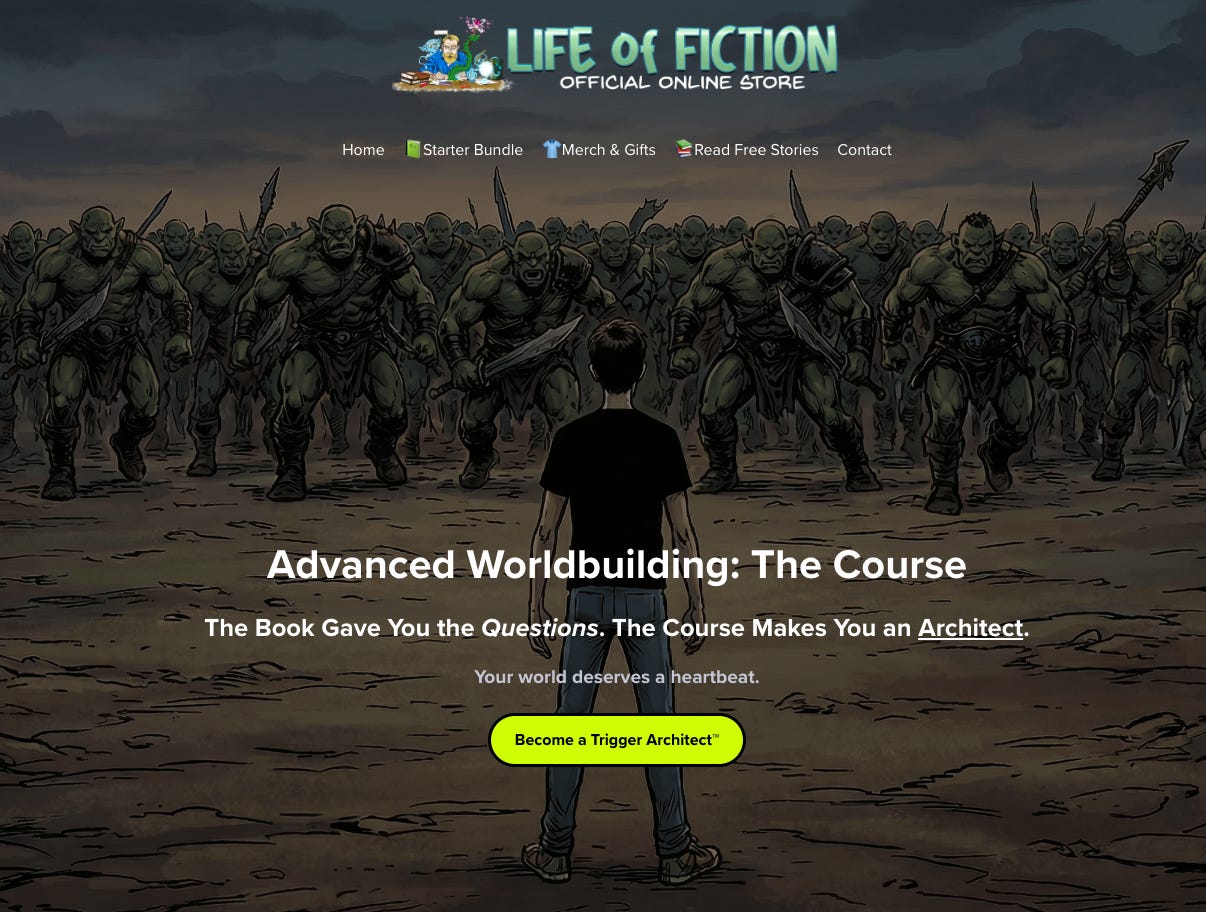
Advanced Worldbuilding: The Trigger Architect™ Masterclass
Build Worlds With a Heartbeat — Not Just Details
What separates a forgettable world from one that lingers in the mind long after the final page?
Structure.
In this advanced masterclass, author and creator Jaime Buckley shares the system he developed to build worlds that breathe — worlds anchored in cause, consequence, and emotional gravity. Through the Up-Chuck Method™ and the discipline of Trigger Questions, you’ll learn how to design catalytic Events, define a living Core, eliminate structural weakness, and construct stories that withstand scrutiny.
This is not just a creativity workshop. It is architectural training for serious builders.
Perfect for fantasy and science fiction writers who believe their stories deserve more than surface detail — and are ready to build them accordingly.