


Let me ask you something personal.
Not about your plot.
Not about your magic system or your map or your character’s tragic backstory.
I want to ask about the feeling.
You know the one.
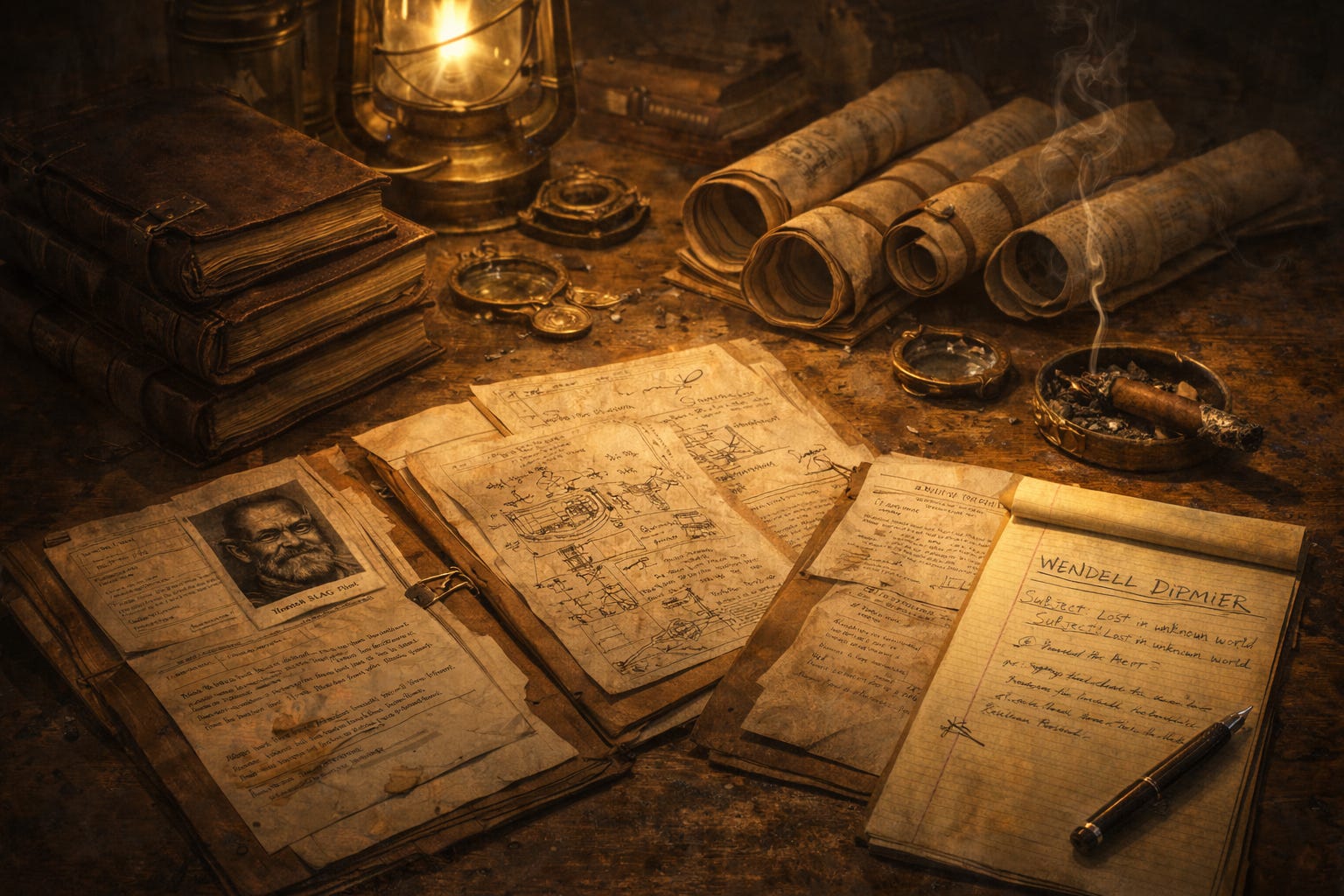
You’re sitting at your desk, or your kitchen table, or wherever it is you write, and you’ve got pages.
Notes.
Folders, maybe.
A world that has been living in your head for months or years.
People you know better than some of your actual friends.
Places you can close your eyes and walk through.
And something still feels wrong.
Not broken, exactly.
More like…hollow.
Like you’ve built the most detailed dollhouse in the world and can’t figure out why it doesn’t feel like a home.
You push harder.
More detail.
More history.
A whole economic system for a city your protagonist drives through in two paragraphs.
A family tree for a character who appears in one scene.
The thread count of a peasant’s tunic.
And the hollow feeling doesn’t go away.
I know this feeling.
I lived in it for years before I figured out what was actually wrong. And it wasn’t what I expected.
It wasn’t a lack of imagination.
It wasn’t laziness.
It wasn’t even a skill problem.
It was a question problem.
I was asking the wrong questions.
And wrong questions…no matter how many of them you ask, no matter how detailed your answers…build hollow worlds.
The difference nobody talks about
There are two kinds of questions a writer can ask about their world. Most writers only ever discover one of them.
I say this because it shows up in their stories.
The first kind describes.
It asks what things look like, what they’re called, how they work on the surface. These questions feel productive because they generate content. You answer them and your notes grow thicker. Your world feels more elaborate.
But elaborate is not the same as alive.
The second kind of question does something completely different.
It doesn’t ask what something looks like.
It asks why something exists, what it cost to create it, who is still paying that cost right now, and what happens to your story…and your characters…if it ever stops being true.
That second kind of question is what I call a trigger question.
And the gap between those two types of questions is the gap between a world that feels like a set and a world that feels like a place.
Let me show you what I mean with a concrete example.
Same world.
Same element.
Two different questions.
Describing question: What does the magic system look like?
You answer this and you get rules. Maybe limitations. A cool visual. Fire comes from the palms, or power flows through bloodlines, or users go blind after ten years of practice.
Interesting.
Detailed.
Still ‘decoration’.
Trigger question: What happened the first time someone used this power — and what did the world lose because of it?
Now you can’t answer without building history.
You have to decide what the cost was, which means you have to decide what the world valued before that cost was paid.
You have to figure out who witnessed it and what they told their children.
…and what those children built their laws around.
…and whether those laws still make sense three hundred years later when your protagonist is standing in the middle of them wondering why everything feels wrong.
That’s not a magic system anymore.
That’s a living wound the whole civilization is organized around.
One question.
Completely different world.
What ‘hollow’ actually means
When readers put down a book and say “I couldn’t connect to it” or “the world felt flat” or “I didn’t care about the characters” — they’re usually not talking about prose quality.
They’re talking about the absence of weight.
Weight comes from consequence.
From the sense that things in this world exist for reasons, that those reasons have history, that the history has cost someone something real.
That your characters are living in the residue of decisions that were made long before they were born.
Without that, you have scenery.
Beautifully rendered, lovingly detailed scenery that a reader walks past…without feeling anything.
Here’s another example.
Two writers.
Same world element.
Writer A decides her world has a caste system.
She names the castes, designs their clothing, assigns them jobs and districts and a color-coded ranking system.
She spends a week on it.
It looks thorough.
But she’s never asked why it exists.
She’s never asked who built it, what problem they were trying to solve, who they were willing to crush to solve it, and whether that problem is actually solved or just suppressed.
She’s never asked what a person in the lowest caste tells their child at night about why the world is the way it is.
The caste system sits in her world like furniture.
It’s there.
It functions.
It has no heartbeat.
Writer B asks one question before she builds a single rule: What catastrophe happened that made people decide sorting each other into ranks was safer than equality?
Now she has to find the catastrophe.
And finding the catastrophe means finding the fear underneath it.
The fear means finding the specific human weakness it exploited.
That weakness will eventually show up in her protagonist’s psychology whether she plans it to or not.
…because her protagonist grew up breathing the air of a world shaped by that fear.
Same concept.
One of these worlds breathes.
The other is a spreadsheet.
The bluff hiding in your notes right now
Every writer has them.
I still find them in my own work.
A bluff is any element in your world that exists because you put it there, not because anything caused it.
It wears many disguises.
It sounds like: “That’s just how the magic works.”
It sounds like: “The people fear outsiders.”
It sounds like: “There’s an ancient prophecy.”
None of these are wrong as concepts.
They’re wrong as stopping points.
The moment you type one of those sentences and move on without asking why:
without drilling into the specific historical moment that made it true’
without the specific people who were present;
without the specific cost that was paid…
…you’ve placed a bluff in your foundation.
Bluffs don’t usually hurt you in the writing.
They hurt you in the reading.
They’re the reason a reader gets to chapter eight and puts the book down without knowing exactly why.
The reason a beta reader says “something feels off but I can’t put my finger on it.”
The reason you reread your own work and feel that hollow thing again even though nothing is technically wrong.
The structure is standing.
But it’s standing on sand.
What it feels like when it works
I want to describe something that has happened to me more times than I can count. Something that students in the Advanced Worldbuilding course keep writing to me about in almost identical language.
There’s a moment…usually somewhere in the middle of a real worldbuilding session, when you’ve been asking the hard questions instead of the easy ones…where something clicks.
Not dramatically.
It’s quiet, actually.
Almost like a sound you’ve been straining to hear suddenly becoming audible.

It’s the moment you realize your world is answering back.
A character makes a decision you didn’t plan, and you know immediately that it’s right.
It’s not because it fits your outline, but because:
it’s the only thing that person could do…
given everything you now know about where they came from…
and what they’re afraid of…
and what it cost their great-grandmother to survive the thing that shaped their whole culture.
Matthew put it better than I could in his review of the course. He said:
“What makes this course amazing to me, is that it shows me the ideas already IN MY HEAD, but I didn’t recognize them. Still blows me away. It’s like a light popped on in my brain and everything makes sense now. The connections, the conflicts, the histories of the races in my world.”
He’d been about to give up on writing.
He wasn’t lacking imagination.
He was asking hollow questions.
Neil called the process ‘priceless’…not because it’s impressive, but because it stripped away his doubt.
“By creating a strong foundation it encourages my creative spirit to go deeper and wider, since it stands on solid legs. It strips away some of the doubt about my story’s weight and appeal, and gives me the confidence to keep going.”
When your world holds up under pressure, you stop asking yourself whether it’s good enough.
You know what it’s built on.
Shannon doesn’t even write fantasy.
She took the course anyway and said it changed how she thinks about every story she touches…because the principle isn’t genre-specific.
“I love what this course does to clarify story ideas. If you want to write a story that does more, that lingers long in the back of a reader’s mind and affects how they see the world, at least for a while, but maybe longer—maybe for a lifetime—this is a great place to start.”
A world that breathes is a world that breathes.
A consequence that lands is a consequence that lands.
The questions work on any story, in any genre, at any stage of the process.
The thing I can’t give you in an article
Here’s where I have to be honest with you.
I can describe the difference between hollow questions and alive ones.
I can show you examples.
I can point at the gap and say…that right there, that’s what you’re missing.
But the actual system…the specific method for finding your bluffs, dismantling them, and rebuilding them with structural weight…takes more than a few paragraphs to teach properly.
It took me years to develop and refine, and the course is where I walk you through every layer of it, step by step.
Those who complete the course also gain access to my personal Trigger Architect’s™ Workbook as a companion.
That workbook alone contains hundreds of questions organized across every dimension of a world…not to answer for you, but to pressure-test what you’ve already built.
Those questions expose exactly where the sand is hiding under your foundation.
The course isn’t a collection of tips.
It’s the complete system I’ve used to build the Wanted Hero universe since 1990.
The same system that helped a librarian named Erica publish four novels from a single world she built using these methods. The same system that made Shaun…an experienced writer…sigh and wonder where it had been for the last fifteen years.
It will cost you time and honest effort.
That’s not a warning, it’s the point.
If you do the work, you will think differently about every story you build for the rest of your life.
That’s not something I can put in an article.
But it is something I can teach you.
If you’ve read this far and felt that hollow thing I described…the one that lives in your notes even when everything looks fine on the surface…you’re already asking the right question.
The next one to ask is whether you’re ready to fix it.
Offer: Ends March 31st, 2026
Use code ARCHITECT25 at checkout for 25% off enrollment. This is a reader discount for people who found the course through this article, and it won’t stay live indefinitely.
[Enroll here → https://shop.lifeoffiction.com/b/worldbuildingcourse ]
Your world deserves a heartbeat.
Go build it one.
— Jaime

Advanced Worldbuilding: The Course
Build Worlds With a Heartbeat — Not Just Details
What separates a forgettable world from one that lingers in the mind long after the final page?
Structure.
In this advanced masterclass, author and creator Jaime Buckley shares the system he developed to build worlds that breathe — worlds anchored in cause, consequence, and emotional gravity. Through the Up-Chuck Method™ and the discipline of Trigger Questions, you’ll learn how to design catalytic Events, define a living Core, eliminate structural weakness, and construct stories that withstand scrutiny.
This is not just a creativity workshop. It is architectural training for serious builders.
Perfect for fantasy and science fiction writers who believe their stories deserve more than surface detail — and are ready to build them accordingly.