


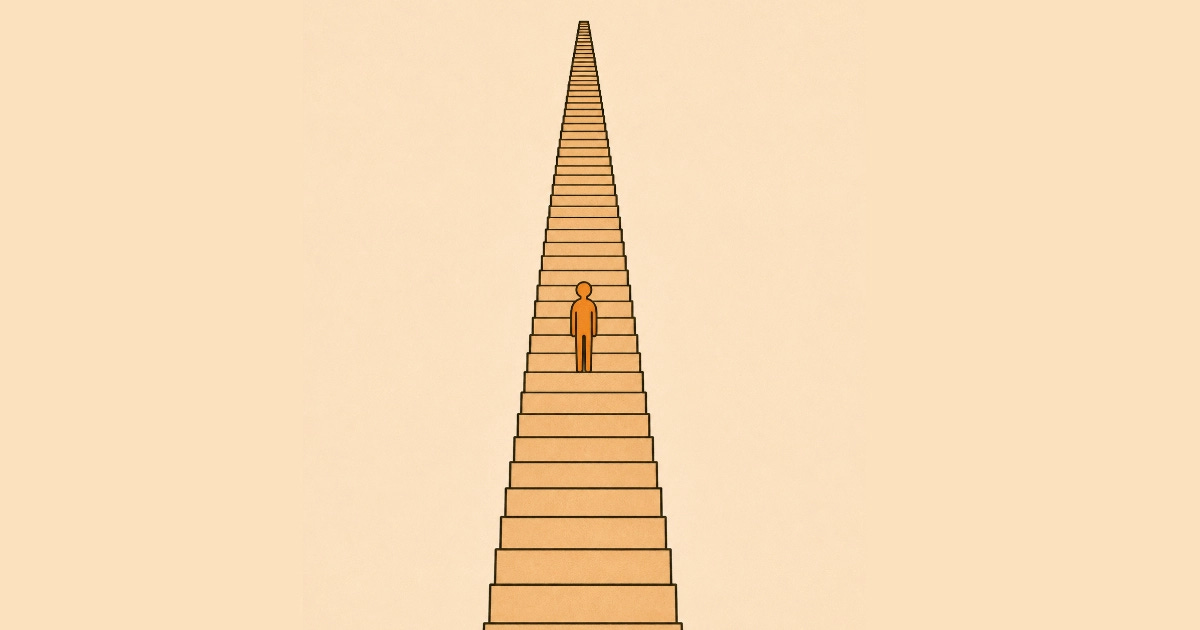
Nobody Talks About the Middle
Every writing article ever written seems to be about beginnings or endings.
How to hook your reader in the first paragraph.
How to stick the landing.
How to open with a bang and close with something that lingers.
Beginnings and endings get all the attention because they’re the parts readers remember most and writers stress about most.
But the middle is where manuscripts die.
Not dramatically.
Not with a crisis you can point to.
They die quietly, somewhere in the second act, when the opening energy has burned off and the ending isn’t close enough to pull you toward it yet. The writer stares at the document and feels... nothing.
Not inspired.
Not blocked exactly.
Just... stuck in a gray zone with no landmarks.
That’s the middle.
And almost nobody teaches you how to survive it.
What the Middle Actually Is
Here’s the thing about the middle of a story...or the middle of a writing career, or the middle of building an audience, or the middle of any long creative project.
It’s not failure.
It’s not stagnation.
It’s not a sign that something is wrong with you or your work.
It’s the part where the transformation is actually happening.
Beginnings are exciting because everything is possible and nothing is at risk yet.
Endings are satisfying because the shape is visible and the work is nearly done. But the middle is where the actual change occurs...in your characters, in your story, in yourself as a writer.
It just doesn’t feel like change while it’s happening.
It feels like being lost.
Think about every character you’ve ever loved in fiction. The transformation that made them worth reading about didn’t happen at the opening scene or the finale. It happened in the long, grinding, unglamorous middle.
In the failed attempts.
The wrong turns.
The moments where they couldn’t see the way forward and kept moving anyway.
You’re writing that part right now.
You’re also living it.
The Specific Lies the Middle Tells
The middle is a liar.
It specializes in a few particular deceptions.
“This isn’t working.”
Sometimes true.
Usually not.
Usually what isn’t working is your proximity to the material...you’ve been inside it long enough that you can’t see it clearly anymore.
The fix isn’t to scrap it.
The fix is distance, a trusted reader, or just moving forward and trusting that revision exists.
“I should start something new.”
The new idea always looks better than the stuck project.
It has no middle yet.
It’s all beginning…all possibility, no problems.
This is the siren song that fills the world with half-finished manuscripts.
Finish the thing.
The new idea will still be there.
“Other writers don’t struggle like this.”
Uhhh, yeah, they do.
Every single one of them.
The ones who seem to move through projects effortlessly either aren’t showing you the struggle or have just gotten better at surviving it.
The middle is universal.
You’re not the exception.
How to Navigate Without a Map
The middle doesn’t come with landmarks. That’s the problem.
So you build your own.
Small targets, not big ones.
In the middle you can’t see the end, so stop trying to navigate by it.
What’s the next scene?
Not the next chapter. The next scene.
Write that.
Then the next one.
The end will appear when you’re close enough to see it.
Trust the outline but don’t worship it. If you outlined the book, the middle is when the outline starts feeling wrong. Characters have become real people and they’re not doing what you planned.
That’s not a crisis...that’s the story finding its truth.
Adjust.
A living story is better than a correct outline.
Mark what’s working.
In the middle, it’s easy to see only what’s broken.
Deliberately identify what’s actually good.
The scene that landed. The character moment that surprised you. The line you didn’t expect to write.
Those things exist in there.
Find them.
They’re the evidence that the story is alive, even when it doesn’t feel like it.
Set a completion condition, not a deadline.
“I’ll finish this draft by March” is easy for the middle to defeat. “I’ll write until this draft is done” is harder to argue with.
The middle wants permission to stop.
Don’t give it a specific date to hide behind.
When I was writing my first version of a horror novel (I know,…me? But it’s true,) the middle refused to behave. I’m a plantser, so my condition was, “I’m going to write this version until it forces me to look over my own shoulder.”
It worked.
For me…AND my readers.
The Other Side Exists
Here’s what I want you to hold onto when you’re in it.
The middle is not permanent.
It never has been.
Every finished manuscript you’ve ever read…every book that changed something in you, every story that made you feel less alone...had a middle. A long, difficult, landmark-free stretch where the writer couldn’t see where they were going and kept going anyway.
They got to the other side.
Not because it stopped being hard.
Because they didn’t stop.
The climb is coming.
It’s already in there, in the pages you’ve written, waiting for you to get close enough to see it.
Keep writing.
“Not Done Yet” is Track 3 on the Gear Girls album Wide Open. This article is part of a ten-piece series built around lines from the album.
Have a listen: NOT DONE YET
The middle is also where most writers abandon their Substack ... right when consistency is about to start compounding. That’s exactly the pattern we break inside Substack for Authors. The framework is built for the long middle, not just the exciting launch.

Needed to hear this today, thank you. Ironically not because I'm stuck in the middle of writing a book. For the first time in my life I got stubborn and finished a book and then finished the quartet, so everything that needs writing at the moment is written! (go me!) But now I'm in the middle of publishing and launching and marketing plans. I'm in the middle of setting up newsletters and author platforms. The end isn't in sight, yet, and I spent all my beginning energy getting book one published (and it is, super excited!) but, yeah, this middle is daunting. But not permanent!
Thank you so much for your article!
You're giving me the heart to carry on. Thank you!