

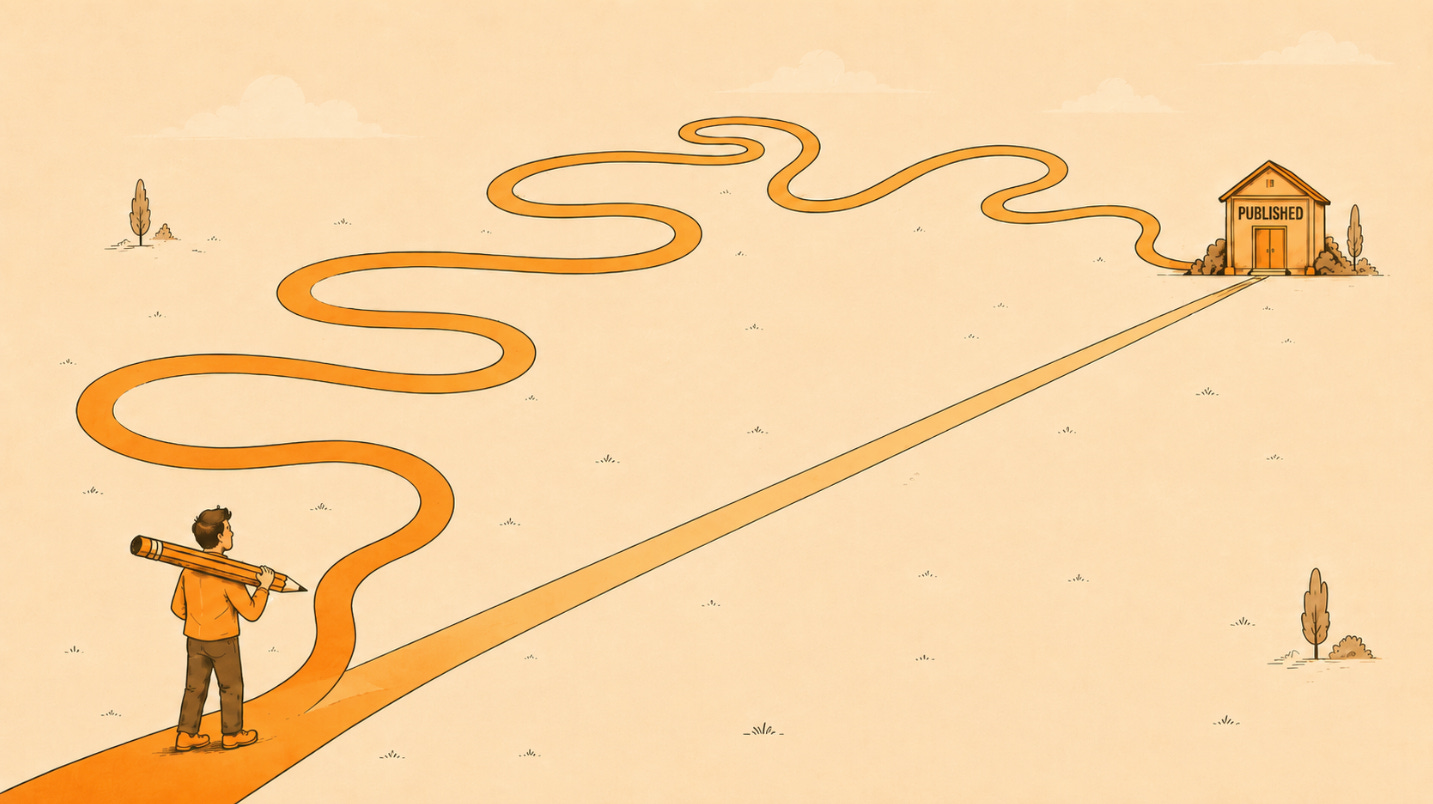
The Thing Nobody Advertises
The internet will sell you faster.
Faster outlining.
Faster drafting.
Faster worldbuilding.
Faster publishing.
Every tool, every system, every course promises to compress the timeline between you and the finished thing.
And look...some of that is real.
Systems help.
Tools help.
Learning from people who’ve already made the expensive mistakes helps.
But there’s a kind of knowing that none of it can give you.
It’s the kind that lives in your hands.
In your gut.
The kind that makes you stop mid-sentence and know something is wrong with a scene before you can articulate why. The kind that tells you a character is lying...not because of what they said, but because of what they didn’t. The kind that makes a reader feel like your world is real because to you, it already is.
That knowing doesn’t come from shortcuts. It comes from the long way.
And the long way is worth it.
What the Long Way Actually Builds
Here’s what I mean.
Back in 2009, when I first started writing Chronicles of a Hero, I wrote scenes I knew weren’t working.
Flat dialogue.
Pacing that dragged.
Characters who said the right things but felt hollow.
I rewrote them.
Still not right.
Rewrote them again.
No shortcut was going to fix that.
Because the problem wasn’t the scene...the problem was I didn’t know my characters yet. I knew their names and their backstories and what they wanted. But I didn’t know how Wendell’s voice changes when he’s embarrassed versus when he’s afraid. I didn’t know which arguments Alhannah walks away from and which ones she can’t let go of.
I learned that by writing badly for a while.
That’s the thing about the long way.
It doesn’t feel like learning while it’s happening.
It feels like struggling.
It feels like writing scenes that don’t work and wondering if you’re the problem.
You’re not the problem.
You’re building the knowing.
The Difference Between Knowing About and Knowing
There are two kinds of knowing in writing.
Knowing about...that’s information.
You can get that from a book, a course, a YouTube video. You can know about three-act structure, about the hero’s journey, about how to write a villain with genuine motivation. That knowledge is real and useful.
But knowing...that’s different.
Knowing is what happens when you’ve written enough bad villains that you can feel in your chest when a new one rings false. Knowing is what happens when you’ve wrestled with a broken chapter for three days and finally found the thread that was missing...and now you recognize that feeling in other chapters before they break.
Knowing is the craft becoming instinct.
You cannot download instinct.
You cannot shortcut your way to it.
I started out with a wild, world-changing goal in my head…all inspired by Terry Pratchett’s Discworld. The very thought of crafting a dynamic, fun, interlinking world, and then living int that world for the remainder of my career seemed impossible.
Could I do it?
I wanted to, but I didn’t ‘know’ if I could.
Then I wrote a book.
Then another.
And another…and on, and on….and on…all linking together.
'Impossible’ soon became possible…and then probable.
I knew I could do this.
The writers who’ve been at this for years have something the writers just starting out don’t yet.
Not talent...talent is distributed pretty evenly.
Not even work ethic.
It’s accumulated reps.
They’ve been wrong enough times, in enough different ways, that they’ve built a kind of internal calibration that’s hard to explain and impossible to fake.
That calibration is what readers feel when a book works.
They can’t always name it.
They just know it feels true.
Shortcuts Have a Hidden Cost
Here’s where it gets sticky.
Shortcuts feel efficient in the moment. And sometimes they are...using a template to structure your outline saves time. Using a beat sheet to check your pacing saves time.
None of that is wrong.
The problem is when shortcuts replace the reps instead of supporting them.
If you’ve never written a chapter that didn’t work and figured out why...you don’t know how chapters fail. If you’ve never built a world from scratch and discovered three chapters in that your magic system has a logical hole...you don’t know how to stress-test a world before it breaks in front of readers.
The shortcut skips the failure.
And the failure was the lesson.
I’m not telling you to be inefficient on purpose. I’m telling you that some things can only be learned by doing them wrong first. And if you shortcut past the wrong, you also shortcut past the understanding.
How to Use This
Practical takeaway...because this isn’t just philosophy.
When you hit the part of the process that’s slow and frustrating and not working... before you look for the hack, ask yourself one question:
What is this difficulty trying to teach me?
Not every difficult thing is trying to teach you something. Sometimes a broken scene is just a broken scene and you need a fresh set of eyes. But a lot of the time, the friction is the signal. It’s the craft telling you there’s something here you don’t understand yet.
Sit with it a little longer than feels comfortable.
Not forever. But longer.
Because the knowing that comes out of that...the thing you figure out in the mess of it...that’s yours permanently.
That goes in your hands.
In your gut.
And the next time you see that problem in someone else’s work, or in your own first draft three manuscripts from now, you’ll know it on sight.
That’s what the long way builds.
That’s what shortcuts can’t buy.
“The Long Way” is Track 8 on the Gear Girls album Wide Open. This article is part of a ten-piece series, each one built around a line from the album.
Have a listenL THE LONG WAY
If you want to go deeper on craft systems that support the long way without replacing it ... that’s exactly what Substack for Authors is built around. The framework doesn’t skip the work. It just makes sure the work you’re doing is the right work.


My children asked me once, what I would change in my past, with what I know now?
My answer?
"...not a single thing."
"But dad, you've been through so much, so many pains and accidents and been hurt so many times. You could avoid all that!""
"Yes. Maybe. And possibly not be in the right place at the right time to meet your mother, be of the certain personality to pursue her, get married and NOT have 13 children?"
I took a deep breath.
"Never. Not in a million years would I change the experiences I've had, good AND bad. I'd do it all over again, as many times as I had to so I could get to right here...right now.""
Huh.
They liked my answer.
(I think my darling wife did also.)