


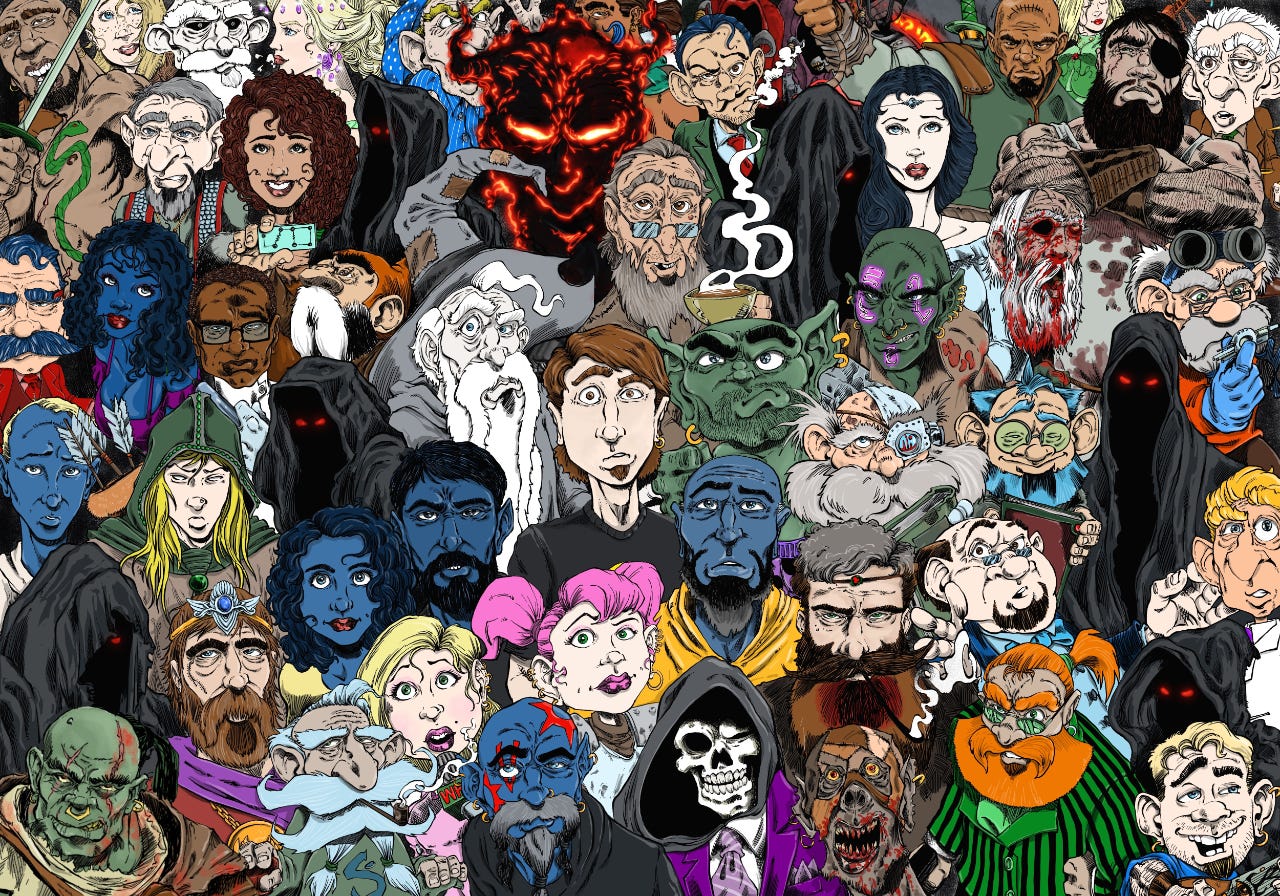
In 2005, I started building a world online called Wanted Hero.
I was a comic book artist with a wife, a growing pile of kids, and a character named Wendell who wouldn’t leave me alone.
When I started this creation, my desire was to craft something that would produce a career.
That was over twenty years ago.
I’m still building it.
Twenty years is long enough to make every mistake worldbuilding offers...and I made most of them twice.
Heh. Apparently I’m thorough.
I built languages nobody asked for.
I mapped places no story ever visited.
At one point I spent weeks creating a menu at my Roadkill Tavern, then cooked those dishes a dozen times in my own home. It worked so well, I had to create the fantasy version of each food, the ecosystem that allowed those foods to grow underground, and then the civilization that would farm them.
You know what nobody tells you when you start down this path?
Almost none of it matters.
Not to readers. Not to the stories. Not to the world itself.
Out of twenty years of building...twenty YEARS...only three things actually moved the needle. Everything else was scaffolding I eventually tore down, or trivia nobody ever asked about.
1. The world had to matter to somebody
Not “be detailed.”
Matter.
Early on I thought depth meant detail.
I just had to pack in more history, add more cultures, and tack on more trade routes between mountain clans.
Hell, I could tell you what my gnomes ate for breakfast.
(still can, BTW)
Nobody cared.
When I created Dathern Istul, a little old book keeper, it was because he reminded me of a family member I love very much. He doesn’t have a big role in my books, and only appeared in one chapter of my series. Yet a reader wrote to me because he reminded her of her grandfather.
Detail is not depth.
Depth is when a piece of your world connects to a person... a character who needs it, a reader who recognizes it.
One connected detail beats a hundred orphaned ones.
Build the things your people touch.
Let the rest stay fog until a story walks into it.
2. Everything needed a Why
Readers can smell a world that was invented yesterday.
Writers often get annoyed when I say this, but it’s true.
They can’t tell you HOW they know.
They just know...
The city feels like a stage set;
The religion feels like a menu option;
The magic feels like a rulebook stapled to a novel.
The difference, every single time, is causation.
WHY is the city here, and not ten miles up the river?
WHY does this faith exist...what fear or hope birthed it?
WHY does the magic cost what it costs?
You don’t need more answers than the story requires. But the answers you have must connect. When they connect, the world feels DISCOVERED instead of decorated...like it was already there, and you just wrote it down.
That’s the feeling readers stay for.
3. I had to keep showing up
This is the one nobody wants to hear, so I’ll say it fast.
This world got good because I didn’t stop.
It’s not about being talented. That might not make sense to say out loud, but I’ve watched builders more talented than me quit in year two.
Several of my friends, brilliant writers, simply gave up and walked away because they didn’t see the exact results they were hoping for. Things didn’t happen as fast as they wanted.
It’s not how this works.
Pause.
This makes me VERY emotional, so I want to say this again, because I want YOU to SUCCEED.
'Fast'….is not how this works.
It's twenty years of Tuesdays.
It's producing chapters when nobody read them.
It's note files older than some of my children.
It's endless pots of coffee consumed to get that last idea onto paper.
A world doesn’t become real in a burst of inspiration.
It becomes real the way a friendship does.
Time, and showing up.
The part I didn’t expect
As I showed up day after day, month after month, year after year, I noticed something interesting.
The world wasn’t the only thing getting built.
Every ‘‘Why I answered taught me how things connect...in fiction, and in my own life.
Every character who needed something showed me what I needed.
Every year I refused to quit built a man who was harder to stop.
I set out to build a world.
The world built me back.
Yeah, I know...sounds strange, but it’s true. That’s the secret sitting under all three lessons, and it’s the one thing I know for certain after twenty years at this table:
You are MORE than you THINK you are.
Your world...the one sitting in your notes, the one you’re embarrassed about, the one with a hundred fragments and no spine...it isn’t just a project.
It’s a forge.
And you are what’s being forged.
So build it.
Badly at first, sure, but that’s what we all go through.
Connect it where it counts.
One Tuesday at a time.
Jaime
Advanced Worldbuilding: The Course
You can feel it when a world is hollow. So can your readers.
You have poured years into your world. The maps, the names, the history nobody asked for yet. And still there is that quiet fear that it is a beautiful set with no foundation...that a sharp reader could push on it and the whole thing would wobble.
Detail is not the problem.
Structure is.
That is exactly what this course fixes.
Inside, Jaime Buckley hands you the same system he used to build a world people have followed for over thirty years. Using the Up-Chuck Method™ and the discipline of Trigger Questions, you will learn to:
Design catalytic Events that force your story to move
Define a living Core so every choice in your world traces back to something that matters
Find and cut the structural weakness before a reader ever feels it
Build a world that holds up under scrutiny...and lingers long after the last page
This is not a creativity workshop. It is architectural training for serious builders. If you believe your story deserves more than surface detail, this is where you stop decorating and start engineering.
Your readers will never see the framework. They will only feel that your world is real.
Build the world that outlives you.