


You know something’s wrong with the manuscript.
You can feel it.
A scene sags. The ending lands soft. A beta reader shrugs and says “I don’t know, it just didn’t grab me”... and you nod, and thank them politely. Then you walk away with a vague bad feeling and absolutely nothing you can actually fix.
You go looking for help.
More and more, the help on offer wants one thing first:
Your book.
Paste it in. Upload the file. Let the machine read it and tell you what’s wrong.
A lot of writers won’t do that.
I understand why.
What writers told me they want
For the last year I’ve listened to writers talk about AI in my classes, in late-night chat rooms, and in a steadily growing pile of emails. They usually start with some version of “can I ask you something?”
Some of them use it every day, and some of them won’t touch it with a ten-foot pole.
It was a HUGE struggle for me, because I didn’t understand it. I wasn’t just afraid to use AI, the other side of the aisle had me afraid NOT to use it!
Can you imagine the conflict in my brain?
It took me a year and dozens of in-depth conversations, asking hundreds of questions, to help me get to the very guarded point I am right now. Yes, I use AI, in very specific ways...all of them to aid me as my health continues to deteriorate.
I use it openly for art and building tools, and I stand behind that.
...but I also stand behind AND support those who won’t.
Let me explain.
The ones who won’t hand over their book usually say one of two things.
“I don’t know where my words go once I upload them.”
Or this one, which stuck with me:
“I don’t want a machine to fix my book. I want to get better at fixing it myself.”
That second writer wants a teacher.
The problem with getting fixed
Here’s what happens when ANY tool rewrites your story FOR you.
That one book gets a little better, and you stay exactly the writer you were.
On the next book you’re right back where you started... staring at the same sagging middle and the same soft ending. You have no real idea why it keeps happening to you, book after book after book.
Most of the holes in a story come from the writer, before they ever reach the page. The motive you meant to settle. The reason your hero can’t just walk away. The clue you knew about... but never actually planted.
Those are decisions.
So what’s the problem?
You can’t outsource a decision you haven’t made yet.
So I built one
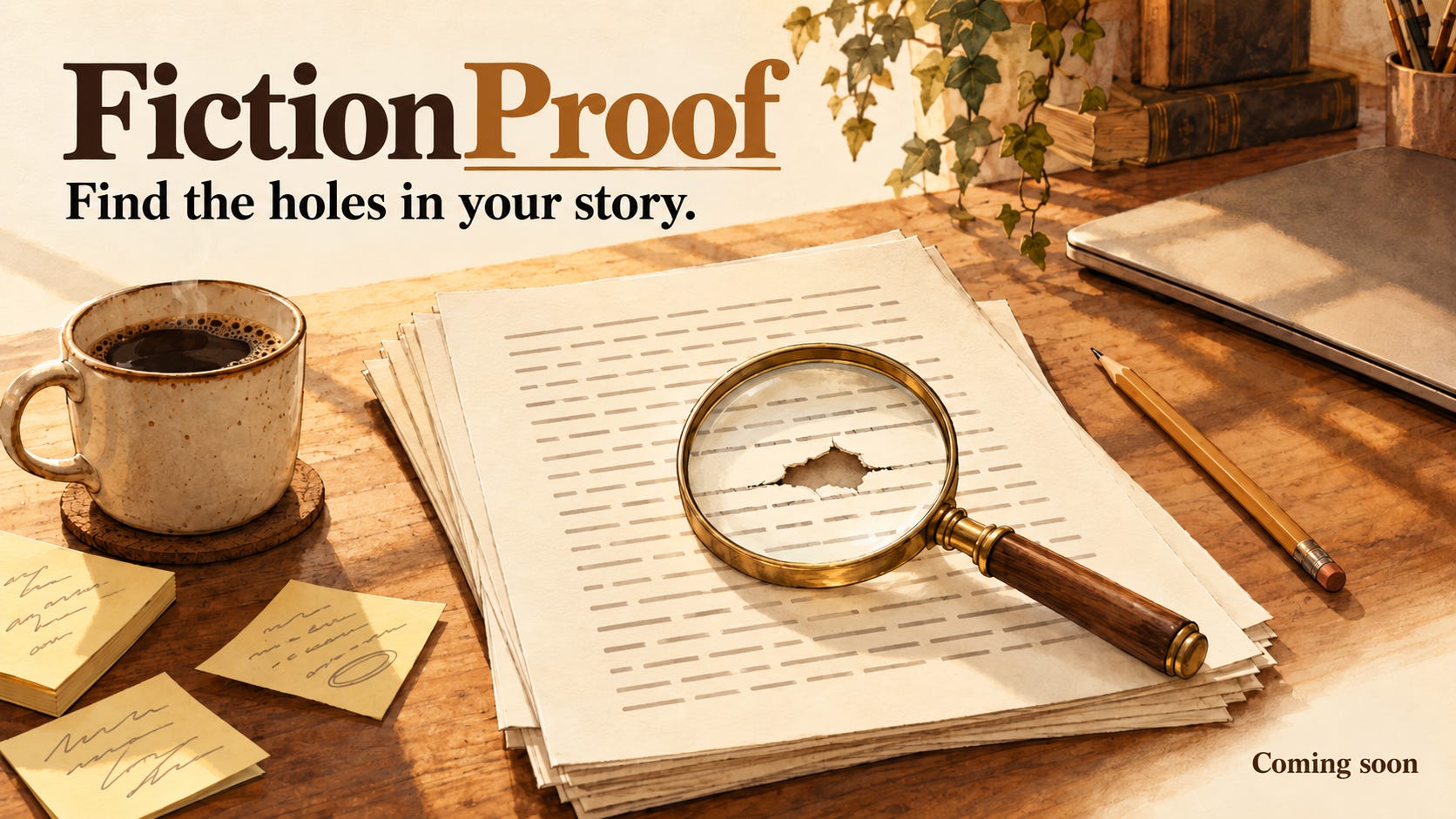
It’s called FictionProof.
It’s a story diagnostic.
You answer short questions about your own story... the kind a sharp editor would ask across the table.
Who is really behind it, and why?
What does your hero believe about themselves that isn’t true?
At the big turns, does your hero make the hard call, or does the story make it for them?
Where you can’t answer, it flags the gap. Where two of your answers can’t both be true, it quietly catches that too. Every flag comes with the reason it matters and an example of it done well, plus a question designed to help you fix it yourself instead of waiting for someone else to do it for you.
Then comes the part I’m proudest of.
It asks you to prove it.
You know your villain’s motive. Great. So where does a reader actually see it, in which chapter and which scene?
If you can’t point to the page, it’s still in your head.
One of our beta testers, mystery author Ann Kimbrough (Tell Me a Mystery), put it better than I can:
“I’d recommend it as a great way to focus on parts of your story that might be more in your head than they are on the page. That’s a huge help.”
Author Shannon W Haynes came in doubtful. After her second run, she wrote:
“I was a little skeptical after the first version, but now I know I am going to use this tool.”
Where your book goes
Nowhere.
FictionProof is a single file that runs in your web browser, on your own computer. No account. No upload. No internet needed once it’s open.
No AI reads, touches, or stores your book. It never sees your manuscript at all... it only asks you questions, and your answers stay on your machine.
It runs on laptop and desktop computers: Windows, Mac, or Linux.
You can back up your work to a file, carry it to a brand-new computer, or open it in a completely different browser, and everything comes right back with you.
It’s yours.
Built for your genre
A mystery breaks in different places than a romance.
FictionProof asks different questions for each. Mystery, romance, fantasy, thriller, sci-fi, and literary fiction each get their own lens, built for the traps that genre falls into. Short story, novella, or novel... the checks are sized to fit.
If you’d rather plan than repair, your answers export as a clean story outline, with every open decision clearly marked, so the tool that checks your finished draft can also help you shape the next one before you write a single scene.
I’ve been writing about Wendell since 1990…and decided to run Chronicles of a Hero through it myself... what it flagged surprised me. I’m already reworking book 8: Howling Shadows to implement what I learned.
Now it checks your characters, too
This week, one of my beta testers, DW Dixon ⚙️⚙️, asked me a simple question.
“Can I run my characters through this?”
I’d been wanting the same thing, so I built it.
Add your cast: hero, villain, allies, mentor, love interest, rival. Each one gets questions built for their role. Your ally gets asked what helping the hero actually costs them. Your villain gets asked what they would call good about what they do... and if you’ve never answered that one, you’re about to find out why it matters.
Then FictionProof lays the whole cast side by side and checks them against each other.
Here’s what a catch looks like:
CROSS-CHECK: Lord Harrow never collides with Mara Venn
Lord Harrow is your villain, but by your answers they neither want what Mara Venn wants nor stand in the way of it. If both of them can get what they want, there is no fight. Find the one thing only one of them can have.
You’d never spot that reading one character sheet at a time. It only shows up when the characters meet.
Every character exports as its own sheet. If you’ve already run your story through FictionProof, your lead’s answers carry straight over, so you never type them twice.
Where it stands
We’re in the final round of beta testing.
Writers have been running their real books through it for weeks, and it’s been tested on Windows, Mac, and Linux, in Chrome, Edge, Brave, Firefox, and Safari. Every round of feedback has changed it... new questions, better answers, and fixes I never would have found on my own.
And it keeps changing after launch. Every copy has a Suggest a refinement button. If your story doesn’t quite fit, or a question feels wrong for the way you write, you tell me in a few lines, and the best ideas ship to everyone in the next update. The tool gets better because writers shape it. Character Mode went from one writer's question to a working feature in a single day.
It’s almost ready.
Try it now, free
You don’t have to wait to see how it works.
I made a free Story Health Scan: twelve questions, any genre, about ten minutes. You’ll get a Story Health score, a map of where your story is strong, and where to look first.
Same promise. It runs on your computer, and your story never leaves it.
Get the free Story Health Scan →
Want to know the day FictionProof opens?
You’ll hear it here first.
Go find your holes.
Then go fill them.
Jaime
The magic is in the questions. You don't know what you don't know and until the challenge of 'prove it' comes along, you will write your book with a fuzzy knowledge of things that need to be absolutes. Then there's the graph at the end that shows, visually, where the sag in the story is and gives helpful cards at the bottom for immediate steps to rectify the sag. FictionProof isn't a quick fix and it will ask some tough questions about your darlings, but it's worth the time.