

The Advice That Doesn’t Work
“Write without fear.”
You’ve seen it.
On mugs.
In writing books.
In the keynote speech at every writing conference ever held.
Write without fear.
Be fearless.
Let go of what holds you back.
Great advice.
Blah-b-blah-blah-blah….
Completely useless.
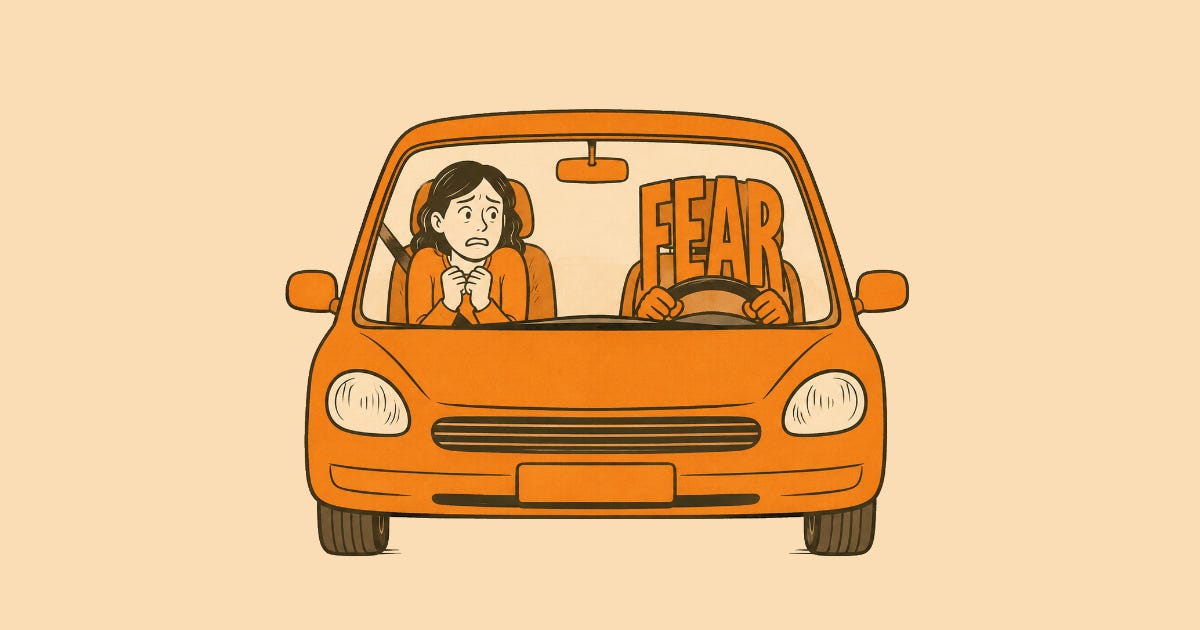
Because fear doesn’t leave when you tell it to. It doesn’t respond to inspirational posters or positive self-talk or the decision that today you’re going to be brave. It just...sits there.
In the passenger seat.
Arms crossed.
Fully buckled in.
The question was never how to get rid of it.
The question is who’s driving.
What Fear Actually Does to Writers
Fear in writing has a specific shape.
It doesn’t usually show up as “I am afraid.”
It shows up as delay.
As perfectionism.
As the chapter you’ve been “almost done with” for six weeks.
As the Substack post you drafted, almost published, then quietly moved back to drafts because something about it felt too exposed.
It shows up as research.
Writers are champion researchers when they’re afraid to write.
Suddenly the magic system needs another three weeks of development. The timeline has an inconsistency that needs resolving before chapter twelve can be written. The character’s backstory needs more depth before the scene where she breaks.
None of that is wrong on its own.
Research matters.
Consistency matters.
Depth matters.
But fear is an excellent mimic. It will wear the costume of diligence and professionalism and craftsmanship right up until the deadline passes and the thing still isn’t done.
The Passenger Seat Principle
Here’s the reframe that actually changed how I work.
Fear is not the enemy.
Fear is information.
It shows up loudest around the things that matter most...the scenes that are most personal, the stories that are most true, the work that has the highest chance of connecting deeply because it came from somewhere real.
Fear has good taste.
It tends to cluster around the good stuff.
So the goal isn’t to silence it.
The goal is to stop handing it the keys.
Fear in the driver’s seat makes every decision. It decides which scenes get written and which ones get endlessly “prepared for.” It decides which posts go up and which ones stay in drafts. It decides how honest you are, how far you push, how much of the real thing actually makes it onto the page.
Fear riding shotgun is different.
It’s still there.
Still talking.
Still pointing out every pothole and questionable turn.
But it doesn’t control the vehicle.
You do.
And you can choose to hear it and keep driving anyway.
That’s not bravery.
That’s just a different relationship with the passenger.
Three Places Fear Shows Up in Your Writing
Knowing fear’s disguises helps you catch it early.
In the blank page…the paralysis before starting. Fear here usually sounds like “I need more preparation.”
The move: write one bad sentence.
Just one.
Fear hates momentum...it prefers the clean stasis of not-yet-started.
In the middle.
This is where most manuscripts die.
The beginning energy is gone and the end isn’t visible yet.
Fear here sounds like “this isn’t working” and “maybe I should start something new.”
The move: identify the next smallest scene you can write.
Not the next right scene.
The next writable one.
Keep moving.
To the finish line.
The draft is done and suddenly there are seventeen more things it needs before anyone can see it. Fear here sounds like “it’s not ready.”
The move: set a deadline with a real human attached to it.
A beta reader, an editor, a publishing date.
External accountability is fear’s natural predator.
The Practical Test
Next time you’re stalling on something...a scene, a post, a decision about your publishing strategy...ask yourself two questions.
First: Is this delay coming from a genuine craft problem that needs solving? Or is it coming from discomfort with how exposed this piece of work makes me feel?
Honest answer only.
Fear is counting on you to misidentify it as diligence.
Second: If I knew this piece would connect deeply with the right readers...if I knew it would matter to someone...would I still be waiting?
If the answer is no...you already know what the delay is actually about.
Write the thing.
Let fear ride along.
It’ll calm down once you’re moving.
It always does.
“Run Toward” is Track 5 on the Gear Girls album Wide Open. This article is part of a ten-piece series built around lines from the album.
Have a listen: RUN TOWARD
Learning to recognize fear’s disguises in your own creative process is foundational work ... and it’s one of the first things we dig into inside Substack for Authors, because it shows up just as much in publishing decisions as it does in the writing itself.


I may be wrong, and it might just be my style, but if something isn't working, instead of avoiding it, write your way through it. Certainly spend time thinking about it, but keep writing. I've found that allowing for a patch of fog in your story, has led, not to endless fog, but to the other side. If you wrote thousands of words to get to the other side, then so what, I guarantee those words weren't wasted. Either you have to make a few adjustments to use it, or you learned more about your characters, story, and world.
Thanks!!